Overview
Lumbini is where Queen Maya Devi, travelling to her parents' home, stopped in a grove and gave birth. The date is disputed; the place is not. Ashoka came here in 249 BCE and left a pillar saying so, and a marker stone found in 1996 sits at the point the tradition names.
It is in the Terai, thirty kilometres from the Indian border, 150 metres above sea level and about as far from the Himalaya as Nepal gets.
The sacred garden
The Maya Devi temple is a plain white building over the excavation. Inside, a walkway crosses brick foundations layered back to the third century BCE, and the marker stone sits under glass.
Outside are Ashoka's pillar, the Puskarini pond where Maya Devi is said to have bathed, and a large Bodhi tree hung with prayer flags where monks of several traditions chant through the day.
The monastic zone
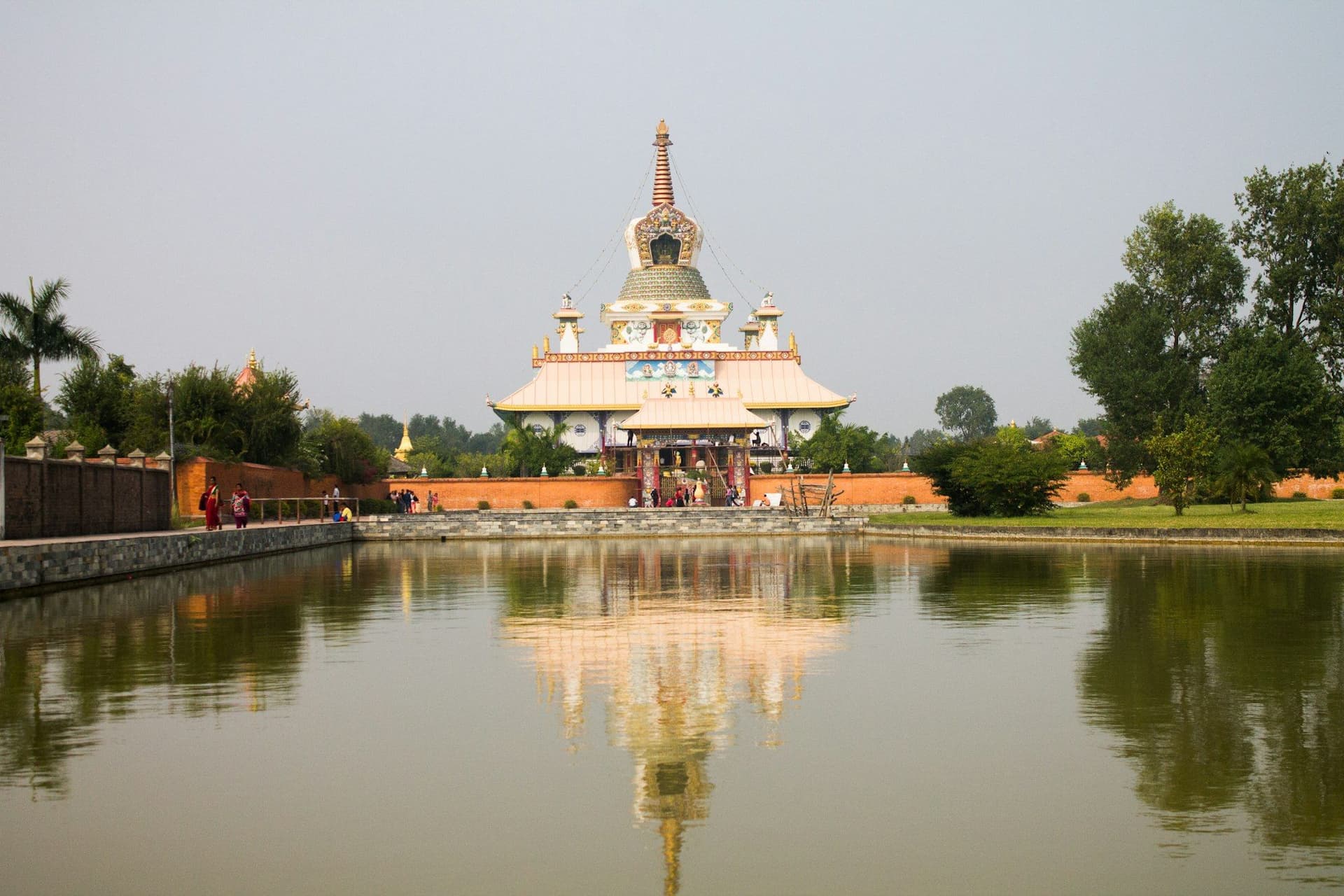
In 1978 Kenzō Tange master-planned a three-kilometre zone north of the garden and invited Buddhist nations to build in it. Thirty have. You can walk from a Myanmar temple to a Thai wat to a German-funded Tibetan monastery in an hour, each in its own national architecture.
Cycle rickshaws work the canal path and are the right way to do it.
Kapilvastu
An hour west, Tilaurakot is the excavated capital of the Shakya kingdom — the palace where Siddhartha lived until he was twenty-nine, and the eastern gate he is said to have left through. Brick foundations, a moat line, mango trees, and usually nobody there.
Practicalities
Fly Kathmandu to Bhairahawa — 35 minutes — or take eight hours of road. Entry to the development zone is NPR 200, the Maya Devi temple NPR 500.
Dress modestly and expect to be barefoot on hot marble. Mosquito repellent is worth carrying; this is the Terai.
Best season
October to March. April to June regularly exceeds 40°C and the monsoon is humid and waterlogged. Buddha Jayanti, on the full moon of May, is the biggest day in the calendar here — and one of the hottest.
Highlights
- The marker stone at the exact recorded birthplace
- Ashoka's pillar, inscribed in 249 BCE
- The monastic zone — thirty countries, thirty architectures
- Tilaurakot, the excavated Shakya palace at Kapilvastu
- Ramagrama, the only unopened original relic stupa
Day by day
The full 4 days
Where you are, what you do, how you travel and where you sleep — each day a structured record rather than a paragraph.
- Day 1
Arrive Lumbini, the sacred garden
Lumbini
- Maya Devi temple and the marker stone
- The Ashoka pillar and the Puskarini pond
- The Bodhi tree and evening chanting
- Transport
- Flight to Bhairahawa, then 45 minutes by road
- Sleep
- Guesthouse, Lumbini
- Meals
- Dinner
- Time
- 4 hours
Shoes come off at the temple entrance and the marble is hot by ten in the morning. Go early or late.
- Day 2
The monastic zone
Lumbini Development Zone
- Cycle rickshaw the length of the central canal
- Myanmar, Thai, Korean, German and Chinese monasteries
- World Peace Pagoda and the crane sanctuary
- Lumbini Museum
- Transport
- Cycle rickshaw
- Sleep
- Guesthouse, Lumbini
- Meals
- Breakfast
- Time
- 6 hours
- Day 3
Kapilvastu and Ramagrama
Tilaurakot and Ramagrama
- Tilaurakot — the excavated Shakya palace and eastern gate
- Kudan and Gotihawa stupas
- Ramagrama, the unopened relic stupa
- Transport
- Private vehicle, about 3 hours' driving
- Sleep
- Guesthouse, Lumbini
- Meals
- Breakfast
- Time
- 8 hours
- Day 4
Morning meditation and departure
Lumbini
- Dawn meditation in the sacred garden
- Onward travel
- Transport
- Road to Bhairahawa
- Meals
- Breakfast
- Time
- 3 hours
Map
Where this tour goes
Price
What $260–$520 covers
Three nights with breakfast, guide and all entry fees; flights extra
Included
- Buddhist-studies guide throughout
- Three nights' accommodation with breakfast
- All monument and museum entry fees
- Vehicle to Kapilvastu and Ramagrama
- Cycle rickshaw within the monastic zone
Not included
- Flights or road transport from Kathmandu
- Lunches and dinners
- Donations at monasteries
Frequently asked questions
What exactly marks the birthplace?
Is Lumbini worth four days?
What is Ramagrama?
When should you go?
About the author
Maya Thapa
Senior trekking writer
Maya has walked more than 4,000 kilometres of Nepal's trail network, from the teahouse highways of the Khumbu to the restricted valleys along the Tibetan border. She writes the route guides and day-by-day itineraries, and returns to most trails every second season to re-check lodge availability, water points and trail reroutes after monsoon damage.
Writes about: Nepal trekking · High-altitude routes · Teahouse logistics